

[On-Site RE:VIEW] The 9th Climate-Energy Summit Seoul (CESS)
2025-07-25
본문
In the Era of Climate Crisis, Will AI Open a New World of Hope or Peril?
■ A Turning Point in Climate Response: Questioning the Role of Technology
On Thursday, June 26, the Climate Change Center and E-Today co-hosted the 9th Climate-Energy Summit Seoul (CESS 2025) at the Korea Chamber of Commerce and Industry. Under the theme "In the Era of Climate Crisis, Will AI Open a New World: Hope or Peril?", the forum explored the multifaceted role of technology in addressing the climate crisis.
The opening speeches focused on the dual nature of technology—its potential and the responsibilities that accompany it.
Jeong-woo Kil, Chair of the CESS Organizing Committee, remarked, “This forum is not about giving the right answers, but about asking courageous questions.”
Jai-chul Choi, Chair of the Climate Change Center, emphasized that “Technology is neither inherently good nor evil. What matters is the standard by which it is designed and used,” stressing the importance of ethical design.
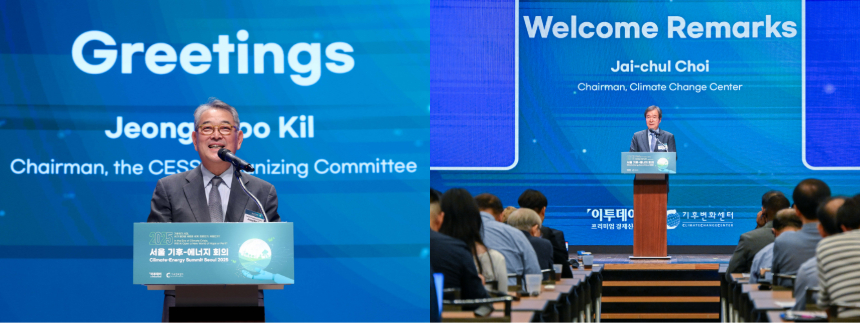
▲ (Left) Jeong-Woo Kil, Chairman of the CESS Organizing Committee / (Right) Jai-chul Choi, Chairman of the Climate Change Center
Se-hoon Oh, Mayor of Seoul, shared the city’s AI-based carbon neutrality initiatives and underlined the role of practice in complementing innovation: “Technology creates the path, but action is what walks it.”
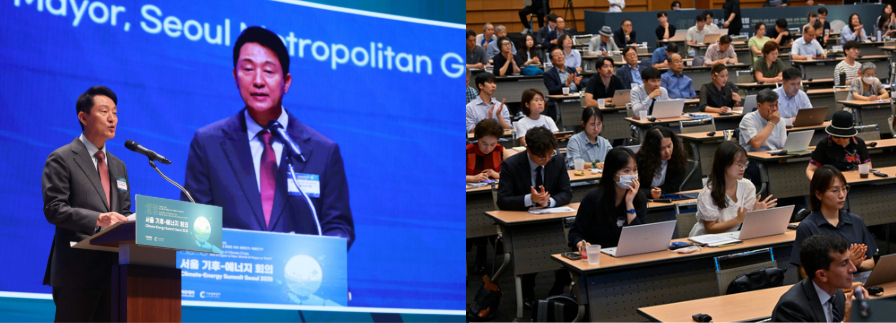
▲ (Left) Se-Hoon Oh, Mayor of the Seoul Metropolitan Government / (Right) General view of the event
■ Keynote Speech: The Double-Edged Sword of AI — The Choice is Ours

▲ Somya Joshi, Head of Division – Global Agendas, Climate and Systems, and Chair of the AI Taskforce, Stockholm Environment Institute (SEI)
Delivering the keynote, Dr. Somya Joshi of the Stockholm Environment Institute (SEI) stated, “AI can worsen the climate crisis, but it can also become one of our most powerful tools to combat it.”
She pointed out that while AI holds great promise for supporting climate action—such as in remote sensing, grid optimization, and supply chain tracking—it also consumes massive energy and resources, creating new environmental burdens.
Dr. Joshi emphasized the need to assess both the efficiency and risks of AI, and called for robust technology governance that questions for whom the technology is designed, and under what value frameworks.
■ Session 1: Climate Misinformation in the Age of AI — The Threat of Digital Spread and Policy Directions
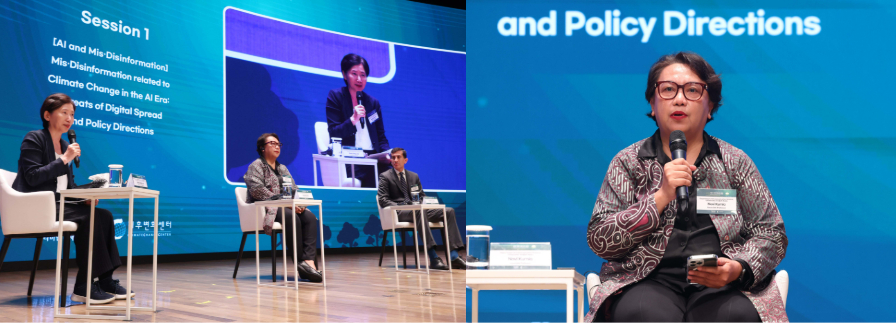
▲ (Left) SookJong Lee, Distinguished Professor, Sungkyunkwan University / (Right) Novi Kurnia, Associate Professor, Universitas Gadjah Mada (UGM), Indonesia
Session 1 explored the theme of how to restore digital trust. As public trust in scientific facts continues to erode, the session focused on how technology, policy, and civic engagement can rebuild a trustworthy information ecosystem.
Sook Jong Lee, Distinguished Professor at Sungkyunkwan University and session chair, emphasized, “Trust in climate information directly underpins the legitimacy of policy implementation.”
The first speaker, Novi Kurnia, Associate Professor at Gadjah Mada University (Indonesia), introduced the current state of climate misinformation in the Global South. She highlighted the importance of digital literacy, AI-powered fact-checking tools, and region-specific content.
In parts of Indonesia, she noted, some segments of the public perceive climate change as a “fabricated political agenda.” This confusion, she argued, stems not from ignorance but from intentional disinformation.
According to a 2024 survey in Jakarta, 98% of respondents said that climate misinformation spreads primarily through social media. While 74% claimed they could identify false information, fewer than 20% had ever refuted it or taken counter-actions.
The second speaker, Daniel Castro, Vice President of the Information Technology and Innovation Foundation (ITIF), addressed misconceptions about AI’s energy use. He emphasized the need to balance concerns over energy consumption with AI’s climate applications—such as in smart grids and disaster response systems.
He explained that 65–90% of total AI energy use occurs during the inference phase, which varies depending on model design, deployment, and optimization level. He also noted that recent advancements in AI chips, algorithms, and hardware have significantly improved energy efficiency, suggesting that fears of an “AI energy explosion” are often exaggerated.
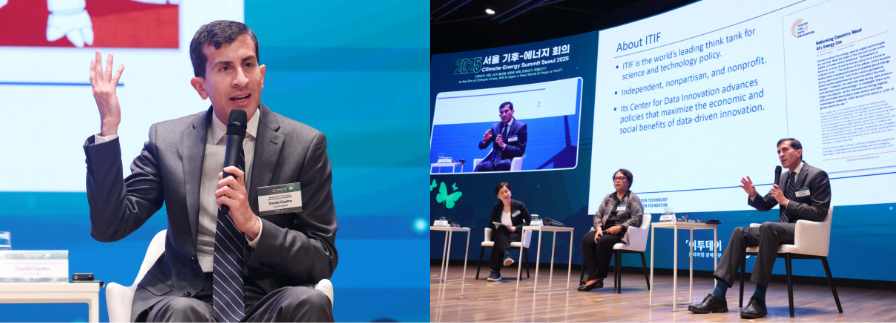
▲ (Left) Daniel Castro, Vice President of the Information Technology and Innovation Foundation (ITIF)
Session 1 reaffirmed that when trust in climate information collapses, society’s overall ability to respond to the crisis weakens.
It concluded that accurate information, social acceptance, and policy design must go hand-in-hand to unlock the full potential of technological solutions.
■ Session 2: Climate Cooperation and Leadership in the AI Industry — Solving Climate-Energy Challenges Through Technological Innovation
Session 2 focused on the roles of industry, media, and energy infrastructure in addressing climate challenges.
JinHyung Kim, Professor Emeritus of Computer Science at KAIST, pointed out, “We have the technologies to diagnose the climate crisis, but what we lack is the social architecture to put them into action.”
Minjung Jin, Principal Researcher at the Korea Press Foundation, cited British journalist George Monbiot, who argued that the media shares responsibility for the climate crisis—not just industry itself, but also the media that legitimized and permitted industrial activities without criticism.
Jin emphasized the need to go beyond simply improving reporting and proposed three core tasks for enhancing the quality and accountability of climate journalism: ▲ Institutionalizing fact-checking systems, ▲Establishing climate reporting guidelines, ▲ Building cooperative models with digital platforms.
She introduced the case of EDMO (European Digital Media Observatory) and France’s climate literacy policy. EDMO is a fact-checking network spanning 27 countries, and in January 2025 alone, 6% of the 1,642 fact-check articles it collected were related to climate misinformation.
France, meanwhile, has institutionalized climate literacy training for journalists as part of a public-sector ecological transition initiative targeting 5.6 million people by 2027.
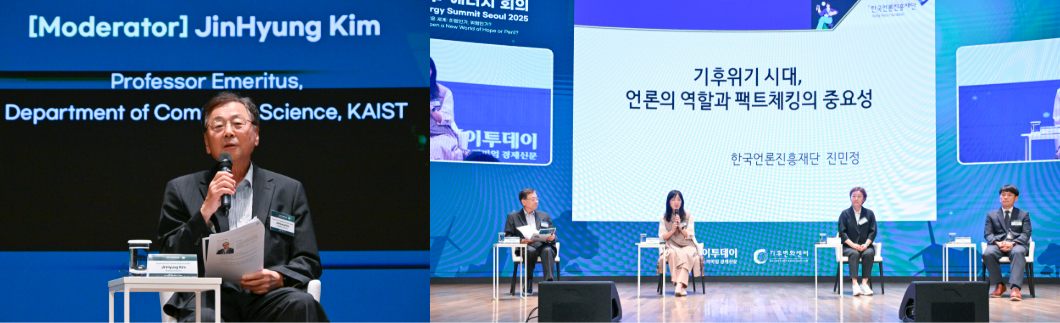
▲ (Left) JinHyung Kim, Professor Emeritus, KAIST / (Right) Minjung Jin, Principal Researcher, Media Research Center, Korea Press Foundation
YongNyuo Shin, National Technology Officer (NTO) at Microsoft Korea, emphasized that companies must go beyond being technology providers and become active agents in reducing societal emissions.
She shared Microsoft’s Net Negative strategy, ESG platforms, and examples of transitioning data centers to renewable energy.
Based on its long-term roadmap (2009–2050), Microsoft has implemented: ▲An AI-based ESG platform (Cloud for Sustainability, Emissions Impact Dashboard), ▲An internal carbon fee system based on department-level emissions, ▲An open climate data platform (Planetary Computer).
Microsoft is also working toward 100% renewable energy use in all global data centers by 2025, exemplified by its fully decarbonized data center in Sweden. This center integrates water-based cooling systems and equipment recycling infrastructure through its Circular Center.
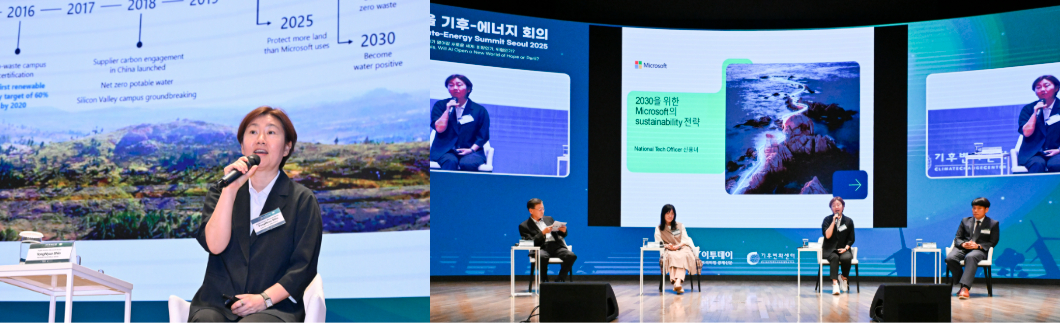
▲ YongNyuo Shin, National Tech Officer (NTO), Microsoft Korea
Jaegul Lee, Team Leader at the Power System Analysis Division, Korea Electric Power Corporation (KEPCO) Research Institute, warned of the dual pressure facing power grids: the rapid growth of the AI industry and intensifying climate disasters.
“Now is a moment of both crisis and opportunity,” he said, stressing the need for coordinated responses across technology, infrastructure, and policy.
He explained that AI industries demand high-quality, uninterrupted power, but current infrastructure is struggling to meet this demand. He proposed four strategies for strengthening the grid: ▲Integration of carbon-free energy sources, ▲Infrastructure enhancement, ▲Advanced operational systems, ▲Flexibility and resilience improvements.
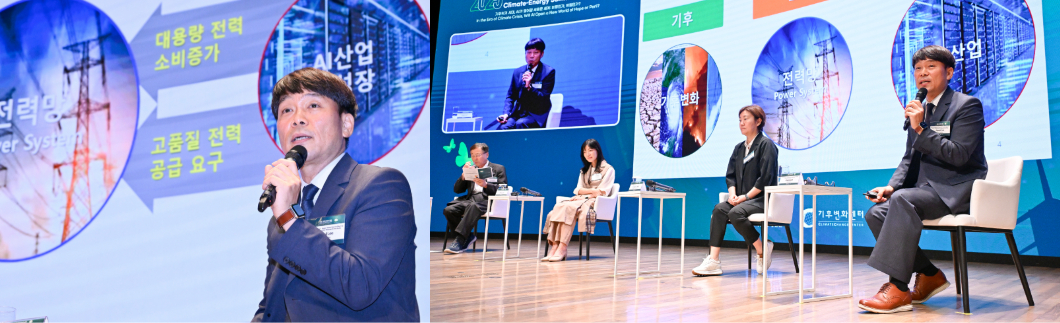
▲ Jaegul Lee, Team Leader, Power System Analysis Team, Korea Electric Power Corporation Research Institute
Session 2 reaffirmed that realizing the full potential of technology requires transparent information, responsible implementation, and cross-sectoral collaboration.
■ Conclusion: What It Takes for Technology to Become a Solution
CESS 2025 brought together diverse issues—AI, energy and infrastructure, and climate information—under a single question:
"Is technology the answer?"
To this, speakers responded with one voice: Technology can be part of the answer, but it is not the answer in itself.
Who designs the technology, for what purpose, and under what value system?
How we respond to these questions will determine the success or failure of our climate response.
How we respond to these questions will determine the success or failure of our climate response.
The Climate Change Center sees this forum as a starting point for exploring sustainable governance that connects technology, society, and the environment.
We hope many of you will continue to walk with us on this path of transition.
We hope many of you will continue to walk with us on this path of transition.


-
[주요소식] 기후변화 리더십 아카데미 24기 수료식 : 탄소중립 혁신과 지속가능한 성장 전략을 모색한 10주간의 여정 마무리
목록
-
[현장스케치] 기후와 AI의 접점에서 미래를 설계하기 위한 여정의 시작, SGI YOUTH+ 4기 발대식과 첫 특강


